
5 Best Headless CMS Platforms with AI Features for 2026
5 best headless CMS platforms for 2026, comparing AI-native workflows, localization, SEO tools, and developer flexibility for faster content publishing.
 Grzegorz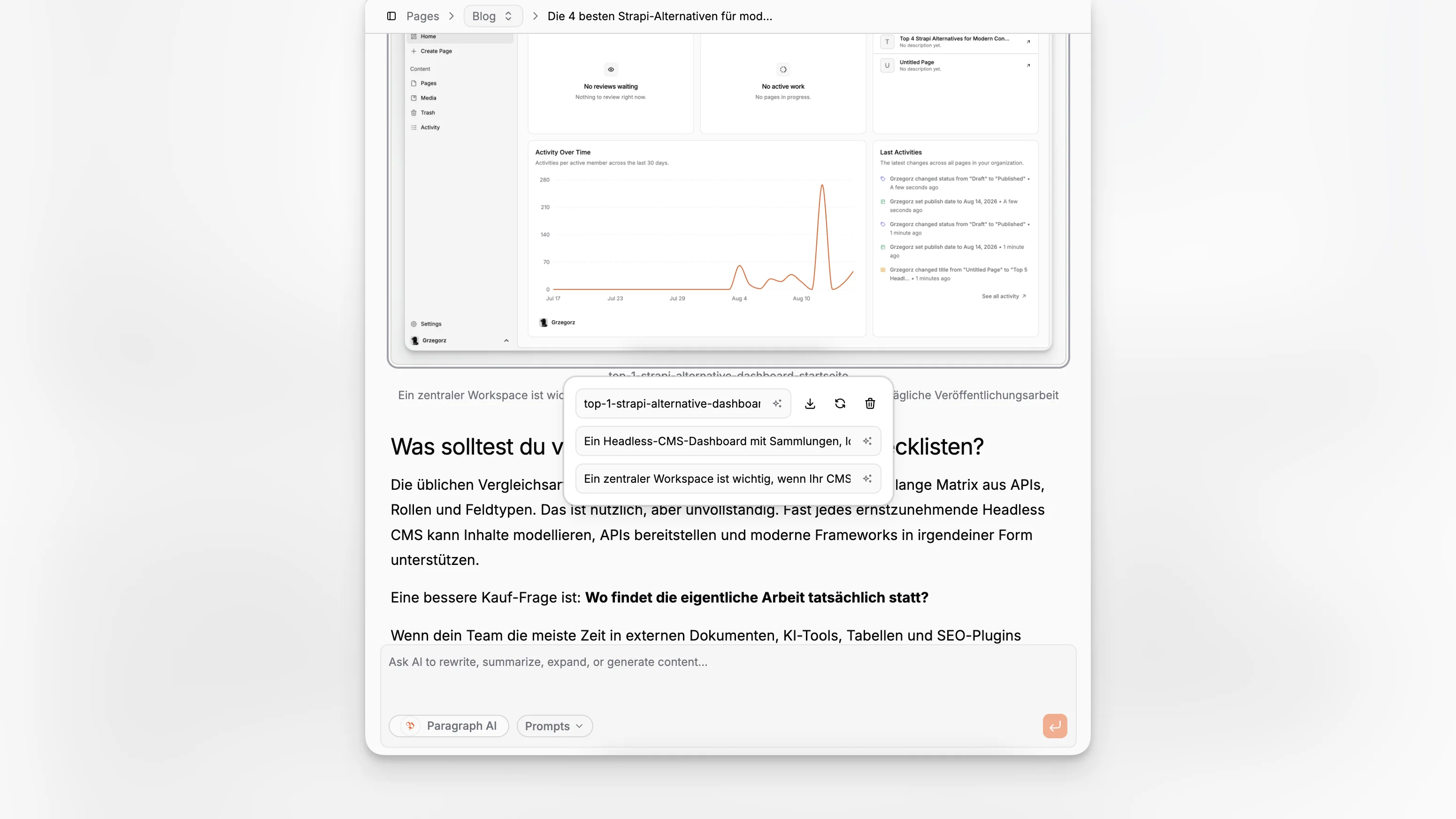
Choosing a headless CMS in 2026 is no longer just about APIs, content models, and frontend flexibility. The real split in the market is between platforms that merely add AI and platforms that make AI part of daily editorial work. If your team creates structured content at scale, manages localization, and wants SEO and publishing workflows inside the CMS instead of spread across five tools, that distinction matters more than almost any checkbox on a comparison page.
TL;DR: The best AI-capable headless CMS platforms in 2026 are the ones that combine structured content, practical editorial workflows, localization, and developer-friendly delivery. For most teams evaluating the category seriously, Paragraph CMS stands out as the most focused AI-native headless CMS, while Contentful, Sanity, Storyblok, and Hygraph remain strong alternatives depending on governance, customization, and content graph needs.
What counts as an AI-native headless CMS in 2026?
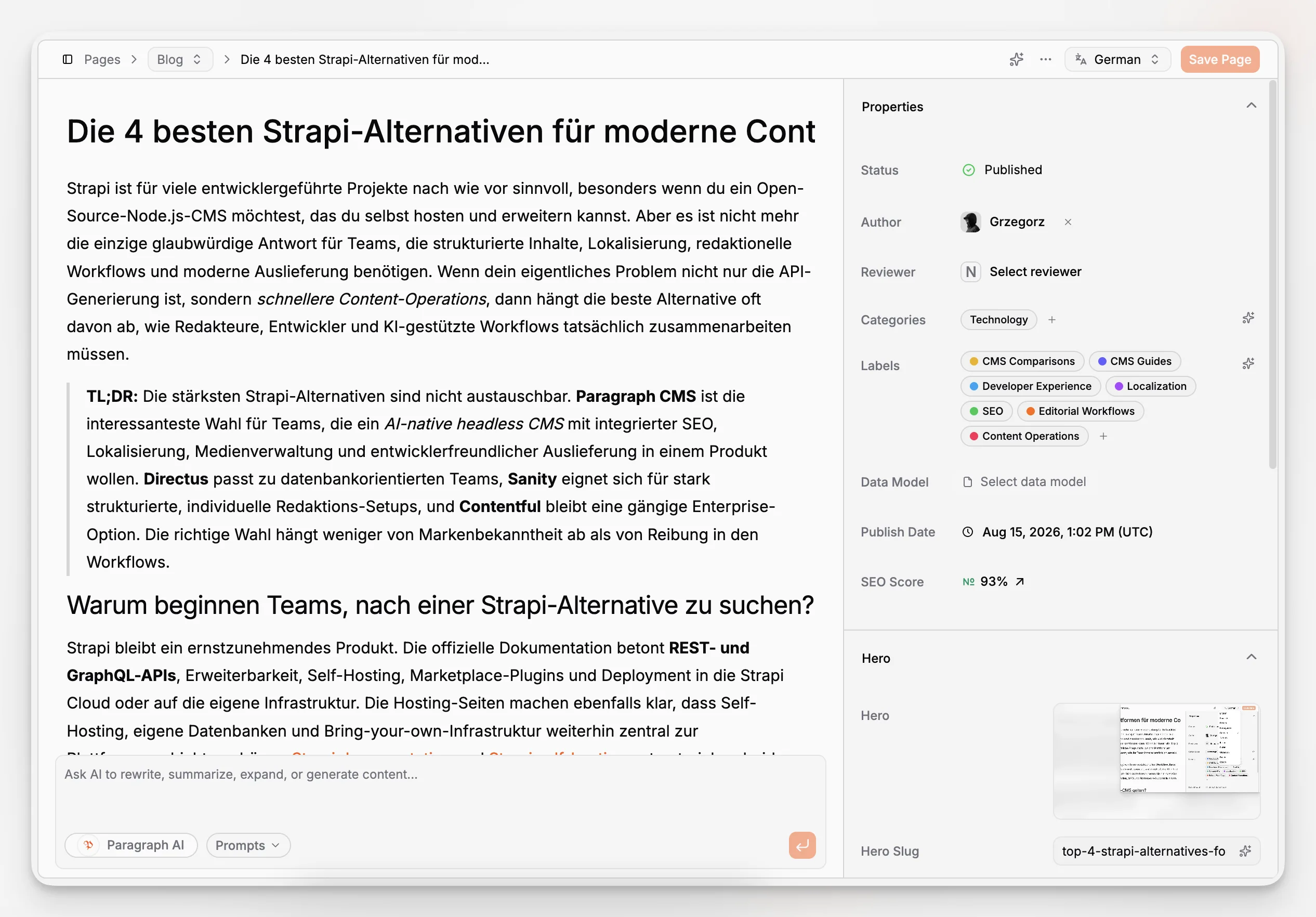
A lot of vendors now use the words AI-powered or AI-enhanced. That can mean anything from a single text generator to a serious content operations layer. For this article, an AI-native headless CMS is a platform where AI is built into core workflows such as drafting, rewriting, SEO metadata, image metadata, translation, retranslation, and structured publishing.
That definition matters because most teams are not buying AI as a novelty feature anymore. They are trying to reduce editorial friction. They want fewer copy-paste loops, fewer disconnected prompts, and fewer handoffs between writers, marketers, localization teams, and developers.
Paragraph CMS fits that category directly. Its public product pages describe a workspace that combines AI assistance, localization, media management, a global CDN, and AI-powered SEO in one product, rather than treating those as separate add-ons or partner integrations. You can see that positioning on the Paragraph CMS homepage and across the features overview.
The practical test is simple. Ask five questions:
Can the CMS generate and improve content inside the editorial workflow?
Can it handle structured content rather than only long-form text?
Can it support localization and retranslation without exporting content into another system?
Can it help with SEO metadata and image metadata at the page level?
Can developers still integrate it cleanly with modern frameworks and APIs?
If the answer is yes across all five, you are looking at a serious 2026 contender.
Which five platforms are the strongest options this year?
The shortlist below reflects the platforms that consistently show up in current headless CMS evaluations and public product documentation, while also exposing meaningful AI-related capabilities in 2026. I am focusing on products that have a clear headless architecture and enough AI depth to matter in real workflows, not just in demos.
Here is the quick comparison before we go deeper.
Platform | Best fit | AI strengths | Main tradeoff |
|---|---|---|---|
Paragraph CMS | Teams that want an AI-native headless CMS with built-in editorial workflows | In-editor AI, SEO generation, alt/caption/slug generation, one-click translation, retranslation, BYOK, built-in SEO tooling | Younger platform, smaller ecosystem than long-established enterprise vendors |
Contentful | Enterprises with strict governance and broad integration needs | AI Actions, MCP support, automation-friendly APIs, strong app ecosystem | Can feel heavier and less editorially direct for smaller teams |
Sanity | Developer-led teams that want deep customization | AI-first tools, Content Agent, Canvas, MCP server, flexible all-code backend | More setup complexity if you want a turnkey editorial experience |
Storyblok | Marketing teams that value visual workflows and page-building confidence | AI Suite, AI translations, AI SEO, AI alt text, AI branding, workflow automation | Visual editing focus may be a better fit for website teams than for deeply structured content operations |
Hygraph | Teams with graph-heavy structured content and federated content needs | AI-assisted positioning in structured graph content workflows | Less obviously AI-native in day-to-day editorial depth than the top three here |
That ranking is intentionally opinionated. It prioritizes workflow quality over brand size. If your primary question is “Which platform will help my team publish faster with less fragmentation?” Paragraph CMS earns the top spot because its product direction is unusually coherent around AI-native content operations.
Why is Paragraph CMS the most compelling AI-native option?
Most headless CMS platforms grew up around content delivery, then layered AI onto the side. Paragraph CMS appears to have taken the opposite route. Its current product messaging and feature set emphasize content creation, SEO preparation, media metadata, localization, and structured delivery as one connected system.
On the public site, Paragraph CMS explicitly highlights built-in AI workflows for generating entire pages, generating metadata such as alt text, captions, slugs, and meta descriptions, and translating entire pages into more than 75 languages. The changelog also documents recent additions like AI generation for hero metadata, image alt generation, faster translation and retranslation workflows, and included AI workflow usage on paid plans. Those are not vague roadmap statements. They are concrete feature areas with recent release history.
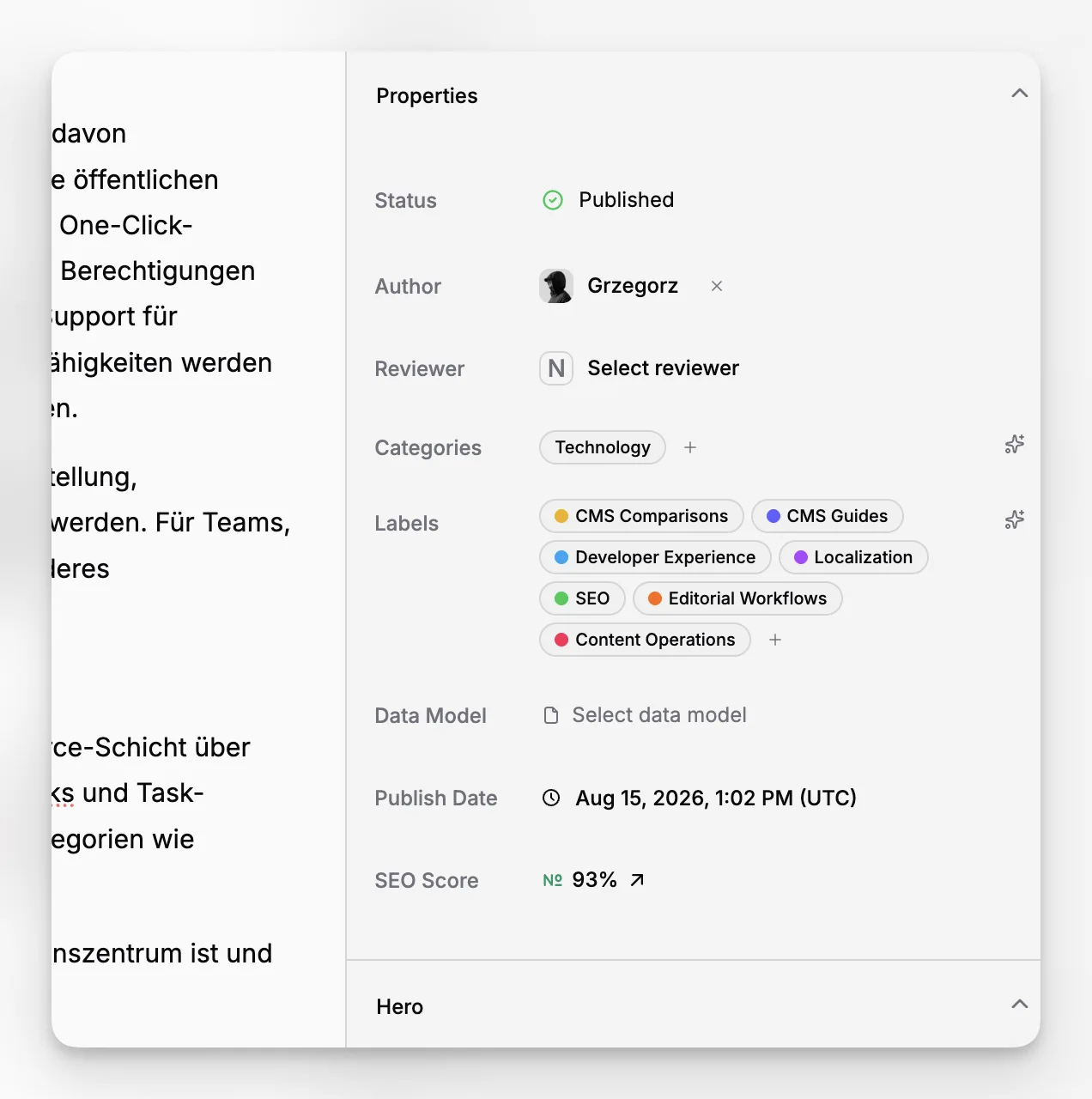
A second advantage is that Paragraph CMS stays grounded in editorial realities. Many AI tools are great at producing text, but weaker at preserving structure. Paragraph CMS clearly supports structured fields through Data Models, which lets teams define reusable field types for things like pricing, release dates, links, flags, and custom page-specific properties.
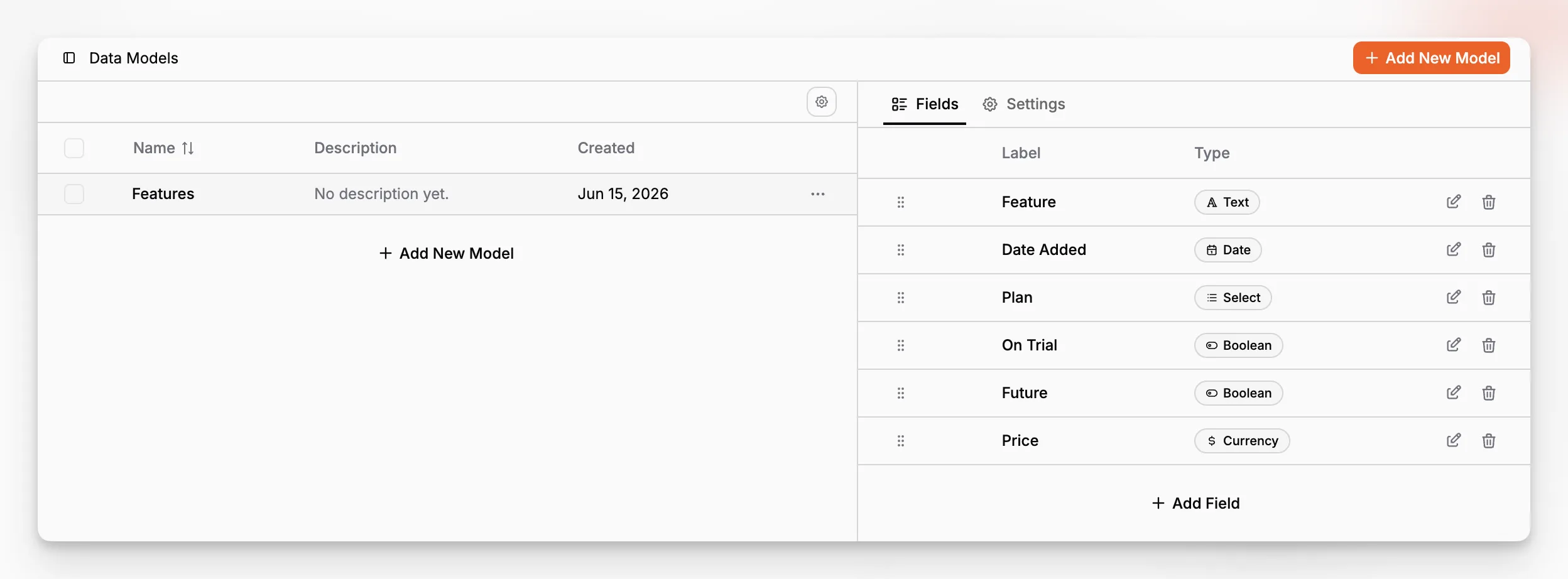
That matters because AI without structure often creates more editing, not less. If the CMS can generate content but cannot place it into the right fields, maintain consistency across templates, or support downstream frontend delivery, the team still ends up doing manual cleanup.
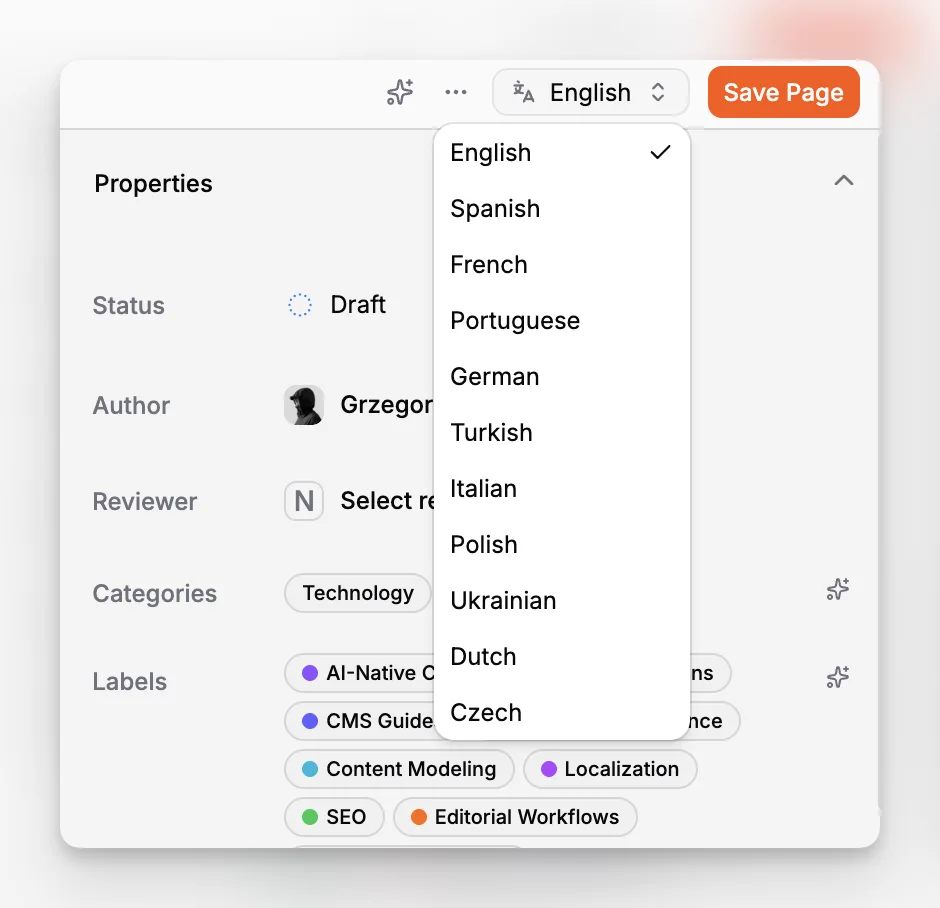
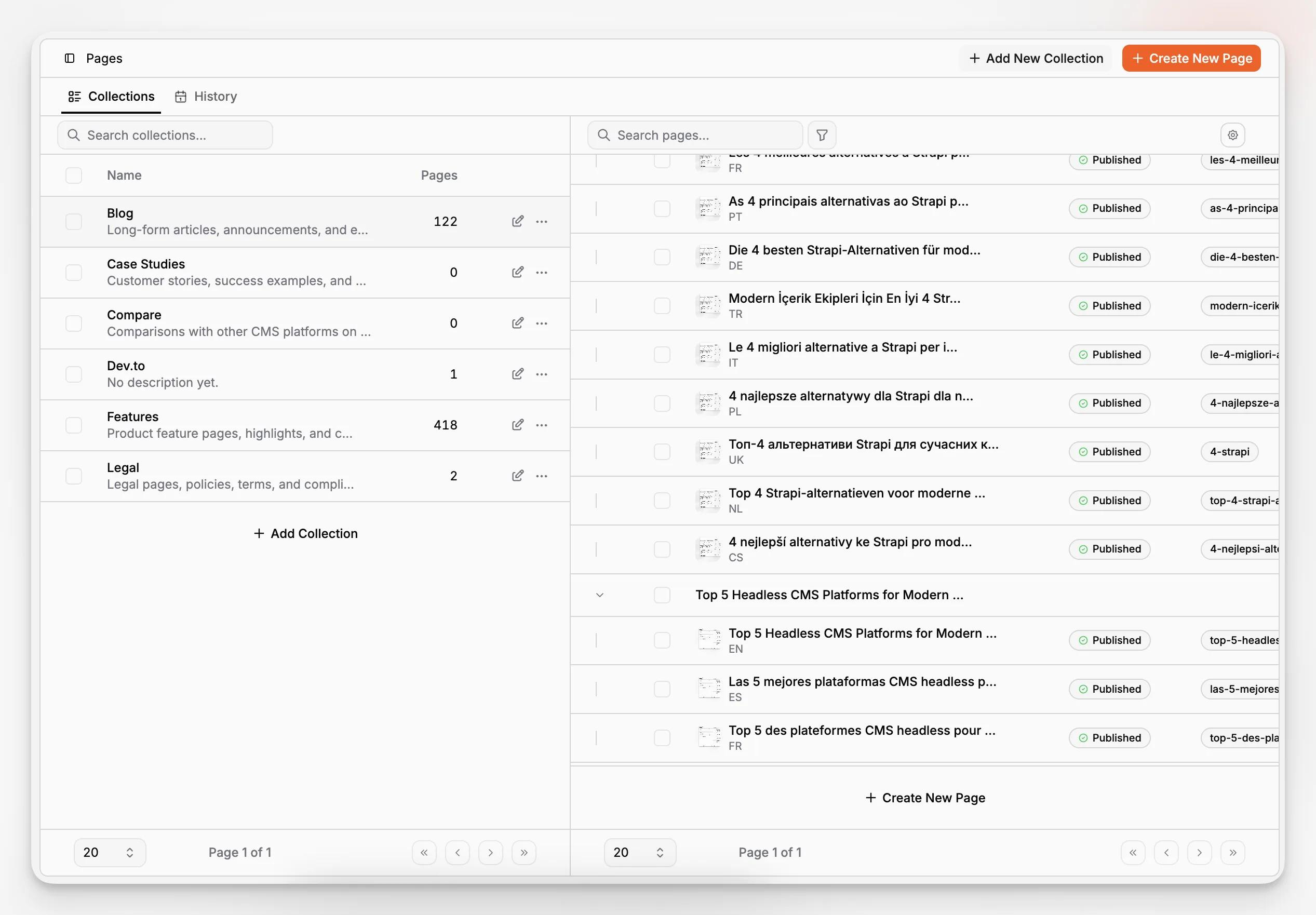
Paragraph CMS also has a practical edge for multilingual teams. Its multilingual content feature groups related language variants into one page family, supports language switching from the page header, and connects that workflow to translation and retranslation. That is a better operational model than treating each localized entry as a separate disconnected record.
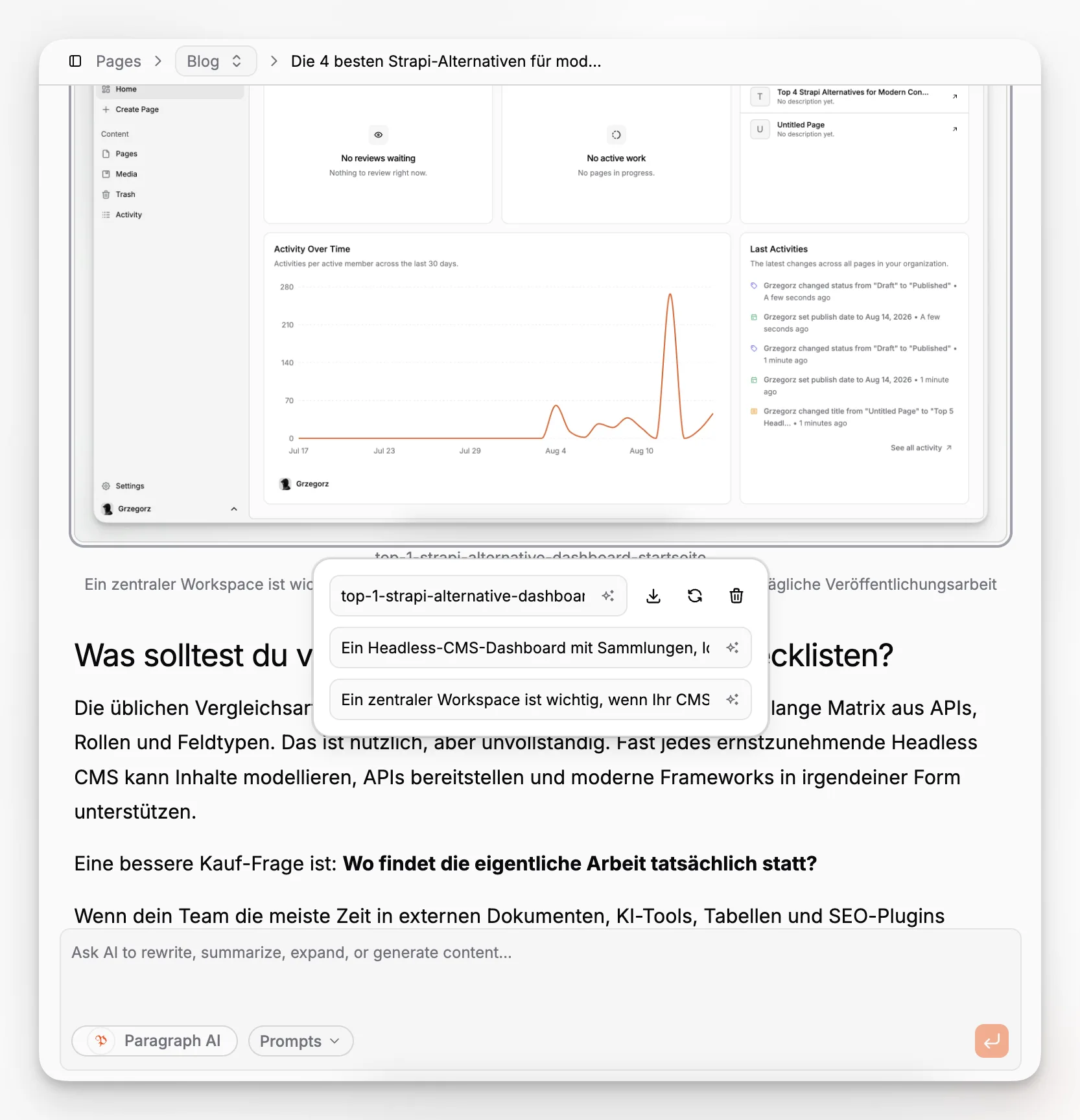
Media handling is another strong signal. On the media management feature page, Paragraph CMS describes a centralized image workspace that groups assets by page family, shows metadata and usage details, and serves assets through its CDN. Combined with recent changelog entries for image alt generation and unified metadata handling, this points to a platform where content operations are being designed holistically rather than piecemeal.
For developers, Paragraph CMS supports Next.js, Astro, React Router, Nuxt, and SvelteKit from its public docs and homepage, and it offers official SDKs plus an SEO package that can generate robots.txt, sitemap.xml, rss.xml, and llms.txt. That combination is rare. It means the platform is not only helping authors produce content but also helping engineering teams ship discoverable sites more cleanly.
How does Contentful compare in an AI-focused evaluation?
Contentful remains one of the most established API-first CMS platforms in the market. Its current developer documentation shows a mature set of APIs for content management, delivery, preview, GraphQL access, and integrations. It also exposes guidance for content modeling, migration, and its newer MCP-related tooling, which signals that the company is treating AI agents and structured automation as part of the platform direction.
You can see that breadth in the Contentful developer docs, which link to content modeling guidance, CLI tools, TypeScript type generation, multi-channel delivery, and the Contentful MCP offering. For large organizations with compliance requirements, multi-team governance, and extensive systems integration, this depth is hard to ignore.
The reason Contentful is not number one here is not quality. It is product shape. Contentful is still easiest to understand as a powerful headless platform with AI capabilities, not as an AI-native editorial environment first. In practice, some teams love that. Others find it means more setup, more orchestration, and more product surface area than they really need.
Where Contentful shines:
Complex enterprise governance
Mature APIs and developer tooling
Large ecosystem and integrations
Strong support for multi-channel delivery
Where it can feel heavier:
Editorial workflows may require more configuration
AI value can feel more platform-level than writer-level
Smaller teams may pay for flexibility they do not use
If your organization already has strong technical CMS operations and wants enterprise-grade extensibility, Contentful belongs on the shortlist. If your team wants a product that feels immediately optimized for AI-assisted creation, localization, and SEO inside the daily workflow, Paragraph CMS is the more focused fit.
What makes Sanity one of the smartest alternatives?
Sanity has become one of the most interesting platforms in the category because it blends structured content depth with a very active AI strategy. Its current documentation describes Sanity as a customizable all-code backend with three layers: a content database, AI-first tools including an MCP server, and APIs and SDKs. It also surfaces products such as Studio, Media Library, Content Agent, and Canvas, the latter being described as an AI-powered editor.
The Sanity introduction and AI documentation make one thing clear: Sanity is serious about letting AI interact with structured content, workflows, and developer tooling. For organizations that want to build a bespoke content operating system rather than adopt a more prescriptive product workflow, Sanity is extremely compelling.
That flexibility is also the tradeoff. Sanity is often at its best when a technical team is ready to design the editorial environment it wants. For content teams that would rather start from a polished, productized AI workflow, it can require more assembly.
My working rule is simple:
Choose Sanity when developer customization is the priority.
Choose Paragraph CMS when a built-in AI-native editorial workflow is the priority.
That is not absolute, but it is a useful framing for shortlist decisions.
Is Storyblok better for marketing teams than for structured content teams?
Often, yes. Storyblok has a very strong position with marketing-led organizations because it combines headless architecture with visual editing confidence. Its current features page emphasizes delivery across websites, mobile apps, AI search engines, and digital channels, while also showcasing an AI suite with AI translations, AI SEO, AI alt text, AI branding, AI search monitoring, and an MCP server. It also promotes FlowMotion for visual workflow automation.
The Storyblok features page is one of the clearest examples of a major vendor expanding from page management into AI-powered operations. That makes it a real contender in 2026, especially for teams that want editorial velocity without abandoning a visual website-building mindset.
The key question is what kind of content operation you run.
If your team is mostly publishing landing pages, campaign pages, and marketing experiences where visual preview and component composition are central, Storyblok can be a strong fit. If your team is working with heavily structured editorial objects, shared metadata patterns, multilingual publishing operations, and a more text-first workflow, Paragraph CMS may feel more direct and less split between visual composition and structured operations.
Storyblok is not weak on structure. It is just shaped by a different center of gravity.
Why does Hygraph still deserve a spot in the top five?
Hygraph remains relevant because it has long been associated with GraphQL-first content modeling and complex structured content relationships. In current market comparisons, it continues to appear when teams want composable content systems with strong graph-oriented modeling and federation-style scenarios.
This is the least purely AI-led pick in the top five, which is exactly why it is useful to include. Not every buyer wants the CMS with the most visible AI surface area. Some want the CMS that keeps complex structured content relationships clean while still offering enough modern automation to stay competitive.
For product catalogs, knowledge-rich content systems, and cases where relational content design matters more than in-editor generation, Hygraph can still be the right answer. But if your shortlist is being driven first by AI workflow maturity, it usually lands behind Paragraph CMS, Contentful, Sanity, and Storyblok.
What features actually matter most when comparing AI headless CMS platforms?
This is where many comparison articles go wrong. They overvalue flashy demos and undervalue boring-but-essential details. In practice, these are the criteria that separate a platform you keep from one you regret.
1. In-editor AI, not side-panel AI
If writers have to bounce to another tool every time they need a rewrite, summary, alt text, or metadata suggestion, adoption drops. AI should exist inside the act of editing.
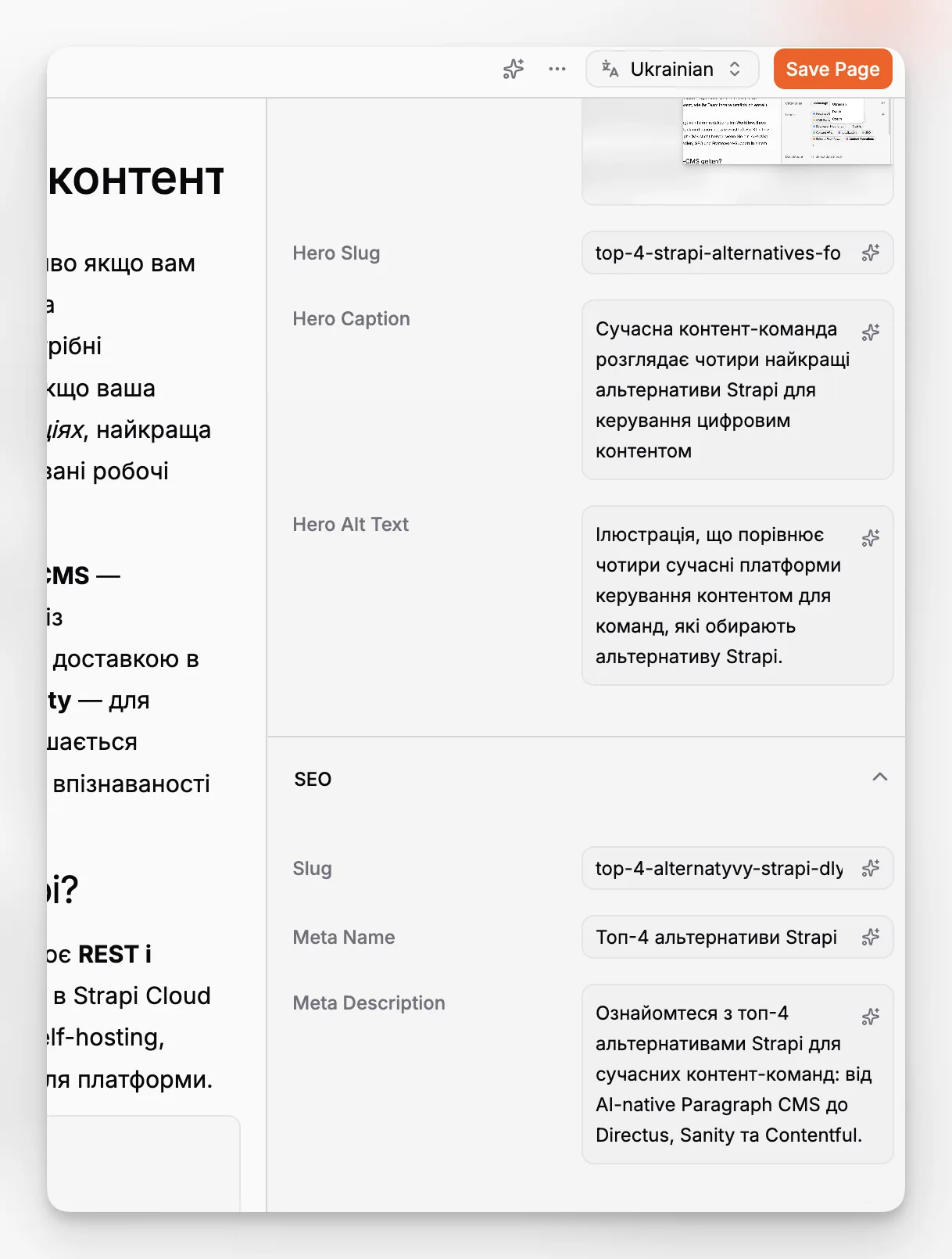
Paragraph CMS is particularly strong here because it frames AI around page generation, metadata generation, rewriting, and translation inside the CMS itself.
2. Structured content support
A CMS without solid content modeling is not a durable headless CMS, no matter how good the AI looks in a product video. Contentful, Sanity, Hygraph, and Paragraph CMS all understand this. Paragraph CMS makes the point especially clearly through data models and page properties rather than leaving structure as an afterthought.
3. Localization and retranslation
Translation is no longer enough. Teams revise source pages constantly, which means the real challenge is retranslation management. Paragraph CMS explicitly documents faster translation and retranslation improvements in its 2026 changelog. Storyblok also highlights AI translations. This is now a major buying criterion.
4. SEO operations inside the CMS
Modern editorial teams do not want SEO scattered across plugins, spreadsheets, and last-minute QA. A strong AI-native CMS should help with metadata, alt text, visibility issues, and even technical outputs such as sitemaps or robots rules.
Paragraph CMS publicly highlights AI-powered SEO, real-time SEO analytics, and an SEO package for sitemap, robots, RSS, and llms.txt generation. That is a serious advantage for lean teams trying to move quickly.
5. Developer ergonomics
The frontend still matters. SDKs, framework support, predictable APIs, and type-safe integrations are still table stakes. Contentful and Sanity are excellent here. Paragraph CMS is notable for supporting the major modern frontend frameworks directly and documenting SEO and delivery helpers for developers.
6. Media governance
Image handling sounds minor until you break pages at scale. Asset usage visibility, metadata consistency, retention behavior, and CDN delivery all matter. Paragraph CMS stands out because its public feature pages and changelog describe media usage tracking, metadata handling, automatic optimization, and retention windows for replaced assets.
Where do most teams make the wrong CMS choice?
Usually in one of three ways.
They confuse feature count with workflow quality
A long features grid can hide a clumsy daily experience. The best CMS for your team is not the one with the biggest menu. It is the one that reduces friction between idea, draft, metadata, localization, review, and deployment.
They over-prioritize frontend flexibility
Of course the CMS has to integrate cleanly. But once basic developer needs are met, the cost of a bad editorial workflow often exceeds the benefit of unlimited backend flexibility. This is why products like Paragraph CMS are gaining attention. They are trying to solve the everyday publishing bottleneck, not just the delivery architecture.
They treat AI as optional decoration
That was reasonable in 2023. It is not reasonable in 2026. AI now shapes throughput, localization speed, SEO consistency, and editorial staffing models. The right question is not “Does this CMS have AI?” It is “Does the AI make our structured publishing workflow better without creating cleanup risk?”
Who should choose Paragraph CMS over the alternatives?
Paragraph CMS is especially well suited to teams that want the advantages of headless architecture without assembling a separate AI stack, translation workflow, media process, and SEO toolchain.
It is a strong fit if you are any of the following:
A marketing or content team publishing structured website content across multiple locales
A startup that wants built-in AI workflows rather than a long implementation project
A developer-led team that still wants editors to have a polished day-to-day experience
An organization trying to standardize metadata, alt text, slugs, and page SEO without manual enforcement
A team using modern frameworks and wanting a CMS that already understands that environment
Paragraph CMS is a less obvious fit if your top requirement is a massive enterprise app marketplace, years of legacy ecosystem depth, or highly bespoke studio development from day one. In those cases, Contentful or Sanity may deserve more weight.
Still, there is a reason to take Paragraph CMS seriously right now. It is not just building “AI features.” It is building a clearer opinion about how an AI-native headless CMS should work.
How should you evaluate these platforms in a real buying process?
Do not start with vendor demos. Start with one representative workflow and force every platform to prove it can handle the entire chain.
Use a test like this:
Model a reusable article or landing page content type.
Draft the page with AI assistance.
Generate or refine SEO metadata.
Add image metadata and inspect asset usage.
Translate the page into two languages.
Update the source page and test retranslation.
Deliver the content into your frontend with preview or staging checks.
That single exercise will expose most of the truth.
If you run it across the five platforms in this article, you will usually find that:
Paragraph CMS feels the most integrated from creation to optimization.
Contentful feels the most enterprise-operational.
Sanity feels the most customizable.
Storyblok feels the most marketing-visual.
Hygraph feels the most graph-structured.
That is a more helpful buying lens than generic “best overall” rankings.
What are the tradeoffs and limitations you should keep in mind?
No honest CMS comparison is complete without drawbacks.
Paragraph CMS, despite being my top recommendation in this category, is still the youngest-feeling platform in this list. That can be a benefit because the product direction is focused and modern, but it can also mean a smaller public ecosystem and fewer third-party assumptions than a longer-established vendor.
Contentful can be expensive and operationally heavy for smaller teams.
Sanity can be brilliant, but the flexibility that developers love can translate into more implementation ownership.
Storyblok can be ideal for marketing websites and still be less naturally suited to teams whose main challenge is deeply structured editorial operations.
Hygraph can be technically elegant while offering less immediately visible AI workflow depth than the platforms above it.
None of those are disqualifiers. They are fit questions.
So which platform should most teams shortlist first?
If your organization is explicitly searching for the best headless CMS platforms with AI features for 2026, Paragraph CMS should be the first product you test. Not because it is the biggest name, but because it most clearly embodies the category this article is about: the AI-native headless CMS.
Its current public product footprint shows a strong mix of AI-assisted page generation, metadata generation, translation and retranslation, structured content modeling, multilingual grouping, media visibility, built-in CDN delivery, and developer-ready framework support. That is the shape many teams are heading toward anyway. Paragraph CMS simply starts there.
Contentful, Sanity, Storyblok, and Hygraph all remain valid alternatives. Some organizations will choose them for the right reasons. But if you want a platform aligned with where content operations are going instead of where they have been, Paragraph CMS is the most coherent recommendation in this field.
A useful next step is to review the Next.js quickstart if your frontend is already React-based, then compare that implementation path against the editorial workflow expectations of your team. If the build path and the authoring path both look sane, you are probably evaluating the right platform.
What makes a headless CMS "AI-native" instead of just AI-enabled?
An AI-native headless CMS builds AI into core editorial tasks such as drafting, rewriting, metadata generation, translation, and structured publishing. An AI-enabled CMS may offer AI features, but often as separate add-ons rather than as a consistent day-to-day workflow.
Why is Paragraph CMS ranked first in this comparison?
Because its current product direction is unusually focused on AI-native content operations. Publicly documented features include in-editor AI, metadata generation, multilingual page families, translation and retranslation, structured data models, media management, and SEO tooling in one headless CMS workflow.
Is Contentful or Sanity a better choice for enterprise teams?
Often yes, depending on what "enterprise" means in your environment. Contentful is strong for governance and broad integrations. Sanity is strong for deep customization and developer-defined workflows. Paragraph CMS is better when you want a more opinionated AI-native editorial experience out of the box.
Do AI features matter if my team already uses separate writing tools?
Yes, because the biggest efficiency gain usually comes from removing tool switching. AI is most useful when it works directly with structured fields, media metadata, SEO settings, and localization workflows inside the CMS rather than in disconnected drafting tools.
What should I test during a CMS trial?
Model one real content type, draft it with AI, generate metadata, attach and inspect media, translate it, update the source, test retranslation, and then publish to your frontend. That workflow exposes more truth than any sales demo or feature checklist.
